

Before You Search “Concept Art Classes Near Me,” Read This

If you have ever paused a game-not because of the gameplay, but because of how it looked—you have already seen the work of a Game Artist in action.
-
The environments that feel alive.
-
The characters that stay with you.
-
The atmosphere you remember long after you stop playing.
None of that is accidental.
Naturally, the next step feels straightforward: you search for concept art classes near me or consider enrolling in a digital illustration course. It seems like the logical way forward.
But this is where most aspiring artists make their first mistake.
They choose a course before they understand the role.
Concept Art vs Illustration: What’s the Real Difference?
At a surface level, both paths look similar. They involve drawing, composition, color, and storytelling. But in the games industry, the purpose behind the work defines everything.
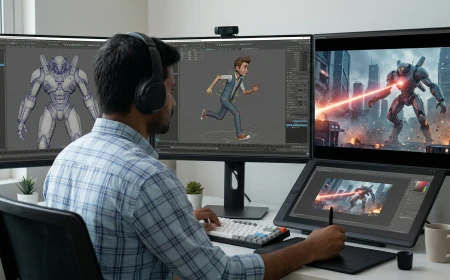
A Concept Artist works at the beginning of the creative pipeline. Their responsibility is not to produce final artwork, but to explore possibilities. They design characters, environments, and moods through multiple iterations, helping teams decide what the game should look like before production begins.
This process is exploratory, fast-paced, and often unfinished by design.
Illustration, by contrast, is about resolution. A digital illustration course trains you to create polished, complete visuals that communicate a clear message or narrative. The work is refined, intentional, and meant to stand on its own.
The distinction can be summarized simply:
-
Concept art develops ideas.
-
Illustration delivers them.
Both are essential, but they lead to very different expectations in a professional setting.
Why This Choice Shapes Your Career
The modern games industry does not reward general effort—it rewards clarity.
Studios hire artists who understand their role within a pipeline. A portfolio that mixes concept sketches with polished illustrations, without clear intent, often signals uncertainty rather than versatility.
This is why many aspiring Game Artists struggle to break in. Their work may be visually strong, but it lacks direction.
A structured digital art course addresses this gap by doing more than teaching tools. It helps you:
-
Build foundational skills with purpose
-
Understand how concept art and illustration function in production
-
Identify your strengths and specialization
-
Develop a portfolio aligned with industry expectations
In other words, it transforms practice into positioning.
What You Actually Learn
A professional illustration course or concept-focused program goes beyond technique. It introduces you to the thinking behind the craft.
You learn how to design characters that serve gameplay, not just aesthetics. You understand how environments guide player experience. You explore how lighting, color, and composition influence mood and storytelling.
More importantly, you learn how to create work that fits into a larger system—assets that developers, designers, and teams can actually use.
This shift—from isolated artwork to production-ready output—is what separates hobbyists from professionals.
Why MAGES Institute Changes the Starting Point
At MAGES Institute, the focus is not simply on learning how to draw. It is on understanding how art functions within the games industry.
Through mentor-led training, production-based projects, and a curriculum shaped by current industry demands, students gain more than technical ability. They gain context.
Whether you begin by exploring concept art classes near me or enrolling in a digital illustration course, the emphasis remains the same: build skills that translate into real opportunities.
Your Next Step
Becoming a Game Artist is not about choosing a course at random. It is about choosing direction first.
When you understand the difference between concept art and illustration, your learning becomes focused. Your portfolio becomes intentional. Your progress becomes measurable.
Before you commit to a course, take the time to understand the path.
Start with the full blog. Then choose a digital art course that aligns with where you want to go-not just what you want to learn.
What's Your Reaction?
 Like
0
Like
0
 Dislike
0
Dislike
0
 Love
0
Love
0
 Funny
0
Funny
0
 Wow
0
Wow
0
 Sad
0
Sad
0
 Angry
0
Angry
0













Comments (0)