

Immersive Augmented Reality Services for Brands That Need More Than Static Displays
AR and anamorphic displays are often placed under the same broad "immersive technology" label.
A static display can be beautiful.
It can be perfectly on-brand, flawlessly fabricated and lit like a luxury campaign.
And people can still walk straight past it.
That is why conversations around Immersive Augmented Reality Services should begin with a larger question: does your brand need information, interaction or spectacle?
Sometimes AR is the answer.
Sometimes touch is better.
And sometimes the problem is not exploration at all—the problem is creating one unforgettable visual moment.
That is where formats such as anamorphic content deserve serious consideration.
Augmented Reality Experience or Anamorphic Illusion: Choose the Problem First
AR and anamorphic displays are often placed under the same broad "immersive technology" label.
They do different jobs.
An augmented reality experience asks an individual to participate through a device or tracked interface.
An anamorphic display creates a shared visual illusion for everyone looking at the screen from an intended perspective.
AR is powerful for exploration.
Anamorphic content is powerful for spectacle.
The mature decision is not "which technology is more advanced?"
It is what behaviour does the brief require?
The Problem With Static Product Launches
Premium product launches often face two competing requirements.
The brand must:
Communicate product features accurately.
And create an emotional moment worthy of the launch.
Traditional screens handle information reasonably well.
They are less effective at making the room itself feel transformed.
That gap is where dimensional visual storytelling can help.
How Anamorphic Illusion Solves the Static-Display Problem
Anamorphic content uses perspective to make imagery on a flat or angled LED configuration appear to have physical depth.
Objects seem to move beyond the boundary of the screen.
The effect is compelling because viewers understand intellectually that they are looking at a display while visually experiencing something that appears to occupy the surrounding space.
Importantly, the illusion depends on:
-
Correct screen geometry
-
Viewing perspective
-
Camera position
-
3D scene design
-
Content scale
-
Precise rendering
-
Physical installation accuracy
A spectacular storyboard cannot compensate for incorrect geometry.
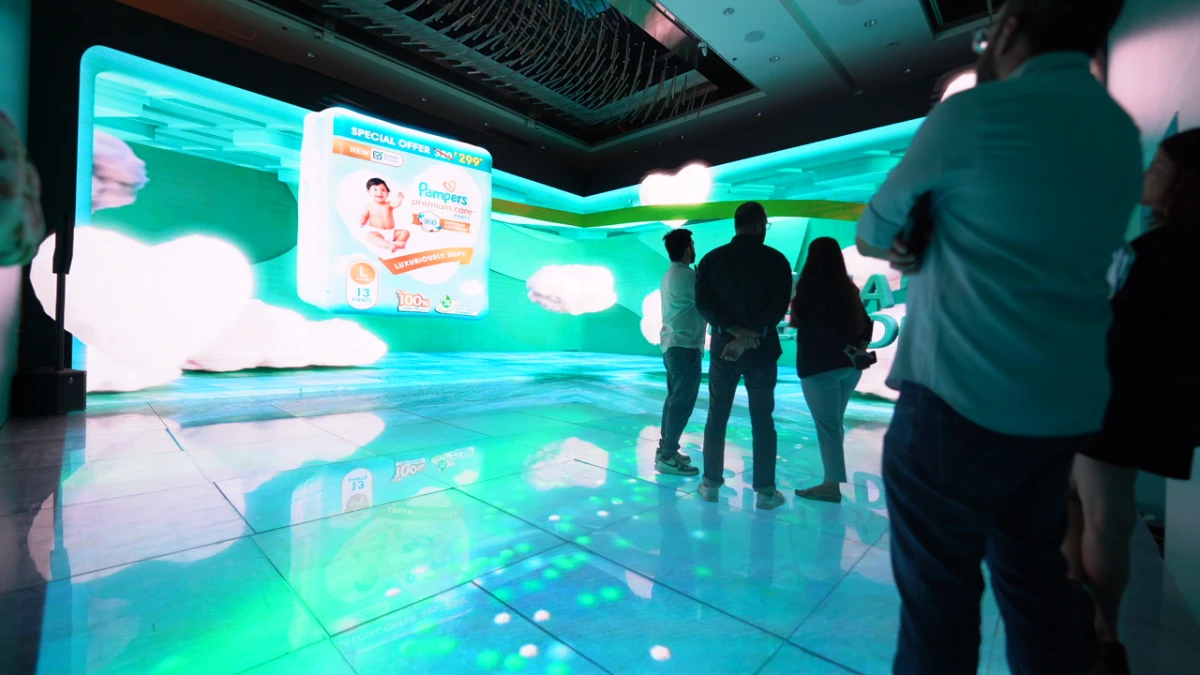
Case Study: Pampers Premium Launch Event
P&G's Pampers team had a particularly sensitive launch brief.
The audience included mother influencers and their babies.
The event needed to communicate the premium product while retaining Pampers' teal, white and gold aesthetic.
A purely technical-looking installation would have felt wrong.
A conventional launch film risked feeling ordinary.
IIC therefore developed an immersive room built around large-scale 3D anamorphic content.
The physical configuration included an LED installation approximately 30 feet by 15 feet, together with a 30-by-30-foot floor LED. IIC developed a perspective-based 3D content pipeline so the product story appeared to extend beyond the normal screen plane.
Explore the Pampers 3D Anamorphic Display case study.
Why This Was the Right Response
The audience did not need to individually scan nineteen data points.
They needed to share a product-launch moment.
Anamorphic content supported that behaviour better than individual tablet-based AR would have.
This distinction is worth remembering when planning Immersive Augmented Reality Services: a strong experiential partner should be willing to recommend something other than AR when the problem calls for it.
Experience Centres Should Mix Shared and Personal Moments
A well-designed experience centre often alternates between two modes.
Shared mode
Large LED displays, projection or anamorphic content bring a group together around one story.
Personal mode
AR, interactive screens, objects or configurators let individuals explore what matters to them.
The rhythm is important.
If every interaction requires a device, the space becomes fragmented.
If everything happens on one giant screen, the experience becomes passive.
Good visitor journeys move between both.
Looking for Examples of Experiential Marketing That Helped B2B Brands?
Anamorphic content is not limited to consumer launches.
For B2B companies, a dimensional display can make invisible or difficult subjects visible:
A data centre can reveal its internal architecture.
An infrastructure company can visualise construction stages.
An automotive brand can separate components of a vehicle in space.
A pharmaceutical company can visualise a mechanism of action.
A real-estate developer can reveal a future environment.
The format works when the subject benefits from scale and visual explanation.
It does not work simply because the marketing team wants "something viral."
Tips for Brands to Create Memorable Interactive Installations
Do not begin with the Instagram moment
Begin with what the visual is supposed to communicate.
Design for the actual viewing position
Anamorphic illusions can break when the installation, camera and content teams work independently.
Make the first few seconds immediately legible
A visitor should not need prior context to understand that something unusual is happening.
Keep the brand inside the story
Putting a logo at the end does not automatically turn spectacle into communication.
Create a content system, not one trick
The reveal can attract attention. Supporting screens, AR or interactive stations can then provide deeper product information.
What Do Retail Brands Gain From Immersive Marketing Activation?
Retail brands usually need both attraction and utility.
Large visual installations can pull people toward a zone.
Then AR can help them investigate products.
For example:
A beauty display could attract shoppers through large-format content before AR supports virtual product evaluation.
A home brand could use the main screen for atmosphere while AR places products into the customer's own room.
An FMCG pack could continue the experience after purchase through augmented reality packaging.
Think of this as an experience funnel:
Attract → Explore → Evaluate → Act
Different technologies belong at different stages.
Technologies Used
A high-impact brand environment may combine:
-
Anamorphic 3D content
-
LED walls and floors
-
AR
-
Interactive touchscreens
-
Projection
-
Spatial sound
-
Object recognition
-
Motion tracking
-
Real-time rendering
-
Custom web or tablet interfaces
IIC's services cover both immersive formats and the supporting interactive/content systems required to create these blended experiences.
Planning Process
For a display-led installation, lock three things early:
Physical geometry.
Exact dimensions matter.
Hero viewpoint.
Where should the illusion look strongest?
Story beats.
What appears first, what surprises the audience, and where does the product feature enter?
Then prototype before full production.
Implementation Timeline
A premium anamorphic installation may require 6-10+ weeks, depending on content volume, screen geometry and approval cycles.
Build time should include:
Concept and storyboard.
3D previsualisation.
Screen calibration.
Content production.
Perspective tests.
Final render.
On-site alignment.
Rehearsal.
Never treat installation day as the first full-scale test.
Space and Infrastructure Requirements
Particular attention should go to:
-
Exact LED dimensions
-
Pixel pitch and resolution
-
Viewer distance
-
Ceiling height
-
Power requirements
-
Media servers
-
Playback redundancy
-
Floor load if floor LED is used
-
Camera positions
-
Ambient lighting
-
Visitor barriers where necessary
The physical environment and digital content must be developed as one system.
Measuring the Outcome
For spectacle-led activation, useful metrics include:
-
Footfall change around the installation
-
Dwell time
-
Recording rate
-
Social content generated
-
Organic reach
-
Brand/product recall
-
Product enquiries
-
Secondary interaction starts
-
Lead or sales actions
For broader measurement thinking, see IIC's guide to augmented reality marketing KPIs, ROI and operational impact.
Frequently Asked Questions
Is anamorphic content augmented reality?
No. Anamorphic content is a perspective-based visual illusion displayed on physical screens. AR overlays digital information onto a real-world view through a device or display system.
Which is better for a product launch?
Use anamorphic content when the goal is a shared reveal or spectacle. Use AR when individual exploration, contextual information or product interaction matters more.
Can they be combined?
Yes. A large visual moment can attract the audience before AR provides deeper personalised exploration.
Does anamorphic content work on every LED?
No. Screen shape, resolution, viewer position and content geometry all affect the illusion.
Your Brand Does Not Need More Technology. It Needs the Right Moment.
A static display is not automatically bad.
An interactive display is not automatically better.
And the most expensive technology in the room is not necessarily the one your audience will remember.
IIC designs experiential campaigns by bringing strategy, physical space, interactive technology, AR, immersive content and custom development into the same conversation.
Explore IIC's Immersive Augmented Reality Services and broader experiential marketing work.
If your next launch deserves more than another beautiful screen, start with the experience you want people to remember. Then choose the technology. Talk to Ink In Caps.
What's Your Reaction?
 Like
0
Like
0
 Dislike
0
Dislike
0
 Love
0
Love
0
 Funny
0
Funny
0
 Wow
0
Wow
0
 Sad
0
Sad
0
 Angry
0
Angry
0












Comments (0)