

Digital Twins in Real Estate for Developers Who Want Stronger Sales Conversations
Every sales pitch has a ceiling. Here's what happens to a conversation once the buyer has already seen everything for themselves.
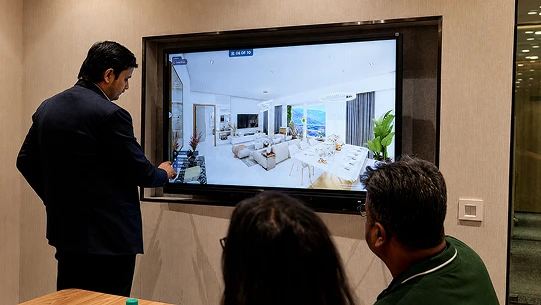
Every sales conversation has a ceiling. A salesperson can only describe a project so well before words simply run out of resolution. "The clubhouse is stunning" and "you'll love the view" are sentences buyers have heard from every developer they've spoken to, and by the third project of the weekend, none of it really registers anymore.
Digital twins in real estate change what a sales conversation is actually capable of. They don't replace the salesperson. They give that person something worth talking about, because the buyer has already seen it for themselves. For developers whose sales conversations feel like they've plateaued, this is usually where the upgrade needs to happen.
The Problem: Conversations That Can't Go Deeper Than the Brochure
Most sales conversations stall at the same ceiling, regardless of how skilled the salesperson is:
-
The pitch has to work for every buyer, so it stays generic
-
Complex, large-scale developments get compressed into a five-minute overview
-
Buyers ask questions the sales team can't visually answer on the spot
-
The same explanation gets repeated dozens of times a day, wearing thin for everyone involved
For large, layered developments especially — multiple towers, extensive amenities, emerging-corridor locations — this ceiling shows up fast. There's simply too much project to explain with words alone.
What Real Estate Digital Twin Technology Adds to the Conversation
A real estate digital twin doesn't just visualise a project. It gives the sales team and the buyer a shared reference point — something both people can look at, point to, and question together, instead of one person describing and the other imagining.
This changes the entire tone of a sales meeting:
-
Questions become specific, "show me the view from here," instead of vague, "what's it like?"
-
Sales teams can adapt on the fly, navigating to whatever the buyer wants to see next
-
Complex, multi-tower or multi-phase projects become explorable as a single coherent whole
-
Every conversation, regardless of who's leading it, draws from the same accurate source
Building Digital Twin Technology for Large, Layered Developments
Estate-scale projects need a different build approach than a single tower:
-
Master-planning at scale — modelling the full site, not just individual buildings, so buyers understand how everything connects
-
Lifestyle continuity — treating amenities as one connected ecosystem rather than isolated features scattered across a plan
-
Extended vicinity mapping — covering a wider radius than a standalone project would need, especially in emerging corridors
-
Multi-pod deployment — building the system to run consistently across several sales pods at once, not just one
This kind of build takes real technical planning, since large-scale environments carry far more geometry and detail than a single building, and performance has to stay smooth despite the added complexity.
Which Projects Benefit From Digital Twins in Real Estate Most
Interactive virtual tours built at this scale matter most for:
-
Large, multi-tower estate developments
-
Projects in emerging or developing corridors, where buyers are betting on a future that doesn't fully exist yet
-
Developments with a genuinely layered lifestyle story, where landscape, amenities, retail, and residences work together
-
Sales operations running several pods or locations that all need the same conversation quality
A Stronger Buyer Journey, Built Through Interactive Virtual Tours
Instead of describing a sprawling estate in a five-minute pitch, a buyer navigates it themselves — the architecture first, then the landscape and amenities as one continuous experience, then the surrounding infrastructure and connectivity, understood not as a bullet point but as something they've actually seen unfold around them. By the time the conversation turns to pricing, the buyer already has a mental map of the entire development.
What Changes for the Sales Team
The sales team's advantage compounds at scale. Instead of juggling explanations for multiple towers, amenity zones, and future phases, they navigate one unified platform live, adapting the story to whatever the buyer is most curious about, in real time.
A Real V-Estate Deployment: L&T Crestoria, Panvel
L&T Crestoria set out to sell a 35-acre residential estate — five towers, Spanish and neo-classical architectural detailing, and a full lifestyle ecosystem including a golf putting course and orchard gardens — inside a still-developing Panvel corridor where much of the surrounding infrastructure was still being built.
V-Estate's approach treated the entire estate as one continuous lifestyle environment rather than isolated buildings and amenities. An interactive vicinity map spanning more than ten kilometres, with 31 mapped touchpoints, let buyers explore Panvel's growth story directly instead of reading about it in a bullet point. Five dedicated sales pods, each running synchronised, high-performance displays, meant every buyer across every pod got the identical experience.
Verified Results
-
Zero-latency exploration across a full 4K digital twin, even at estate scale
-
A single unified platform simplifying what had been an inherently complex, multi-element pitch
-
Immediate adoption by the sales team following training, with no meaningful ramp-up period
-
A scalable framework the developer could extend into future project phases without rebuilding from scratch
Limitations and Planning Considerations
Estate-scale digital twins take longer to build than single-tower deployments, simply because there's more to model accurately, so timelines need to account for that upfront. They also work best when paired with genuinely trained sales teams, since the platform's depth only translates into better conversations if the people running it know how to navigate it fluidly.
Developers exploring what a full digital twin platform looks like at this scale should also read why integrated visualisation is replacing spreadsheet-led sales operations. For large developments, the operational case tends to matter as much as the visual one.
FAQs on Digital Twins in Real Estate
Does digital twin technology work for projects smaller than a full estate? Yes. The scale simply changes what gets modelled. Single towers and estate-scale developments both benefit, just with different build complexity.
How long does deployment take for a large, multi-tower estate? It generally takes longer than a single-tower project, given the added geometry, vicinity mapping, and multi-pod setup involved.
Can multiple sales pods run the exact same experience simultaneously? Yes. Synchronised, multi-pod deployment is specifically built for developments selling across several locations or teams at once.
Does this replace the need for a skilled sales team? No. It removes the burden of constant explanation so the sales team can focus on the parts of the conversation that actually need a human touch — pricing, timing, and trust.
Give Your Sales Team Something Worth Talking About
A conversation is only as strong as what both people can actually see. Talk to V-Estate about building a digital twin that turns your next sales pitch into a conversation buyers actually remember.
What's Your Reaction?
 Like
0
Like
0
 Dislike
0
Dislike
0
 Love
0
Love
0
 Funny
0
Funny
0
 Wow
0
Wow
0
 Sad
0
Sad
0
 Angry
0
Angry
0













Comments (0)