

Clinical Skills Every MBBS Doctor Should Master Before Starting Practice
A medical degree provides the knowledge needed to practise medicine, but knowledge alone does not create clinical competence. Being a good doctor requires patience, empathy, and sharp skills which are built over time and with deliberate effort. This blog talks about the skills MBBS students actually need before they start practice, why clinical examination still holds its ground against modern diagnostics, and how these skills are best built during the training years.
Most MBBS students remember the first time they stood next to a patient and realised textbook knowledge doesn't automatically translate into competent care. The diagnosis might be sitting right there in memory, but applying that knowledge confidently at the patient's bedside, under time pressure, takes experience and repetition.
That is where clinical skills develop along the way. Passing MBBS proves a doctor has acquired medical knowledge but independent practice requires being able to apply that knowledge safely to a real patient.
Table of Content
1. Exam Performance vs Ward Performance
2. Basic Clinical Skills to Master
3. Clinical Examination and Its Role Today
4. Clinical Reasoning, Not Just Procedures
5. How Clinical Skills Are Actually Built
6. Role of Simulation and Skills Labs
7. Communication, Empathy and Teamwork
8. Common Gaps in New Doctors
9. Conclusion
Exam Performance vs Ward Performance
Exams reward recalling diagnostic criteria, recognising textbook presentations, and writing out a management plan on paper. Clinical practice asks questions like deciding what to ask first, recognising when a patient is unstable, picking out which findings actually matter, and knowing which investigation is worth ordering versus which one can wait. Clinical skills for medical students get treated as something that will "come with time," but medical graduates are expected to manage this shift from day one of internship.
Basic Clinical Skills to Master
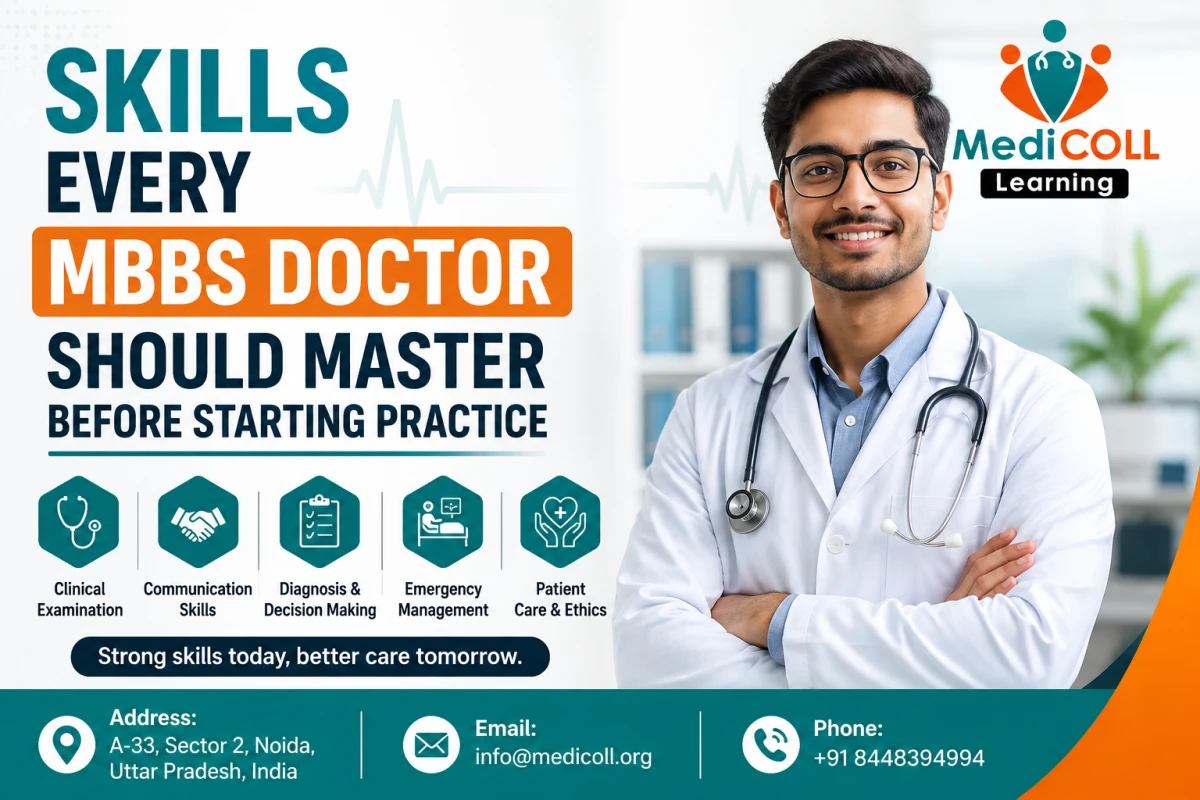
The basic clinical skills every MBBS student needs by graduation fall into a few groups. History-taking, covering presenting complaints, past medical history, drug and allergy history, and relevant systems review. Physical examination across cardiovascular, respiratory, abdominal, and neurological systems.
Clinical interpretation, including vital signs, common laboratory values, basic ECG patterns, and recognising abnormal findings that require escalation. And practical procedures, from venepuncture and IV cannulation to suturing and basic wound care. Clear clinical documentation is equally important, as another doctor should be able to understand the patient's condition, findings, decisions and treatment plan from the notes and follow the case. None of this is conceptually difficult. But what makes it demanding is doing it consistently, on real patients, without assistance close at hand.
Clinical Examination and Its Role Today
There is a tendency, particularly among newer doctors, to lean on imaging and laboratory work instead of a thorough examination. Clinical examination hasn't lost its relevance because of this, even though imaging can sometimes reveal what examination alone cannot.
What examination does is help determine what the findings mean, how urgently they need action, and how the results should be read in context. Strong clinical examination skills prove their worth when a doctor has to decide whether an investigation is actually going to change management or is simply being ordered because it is available.
Clinical Reasoning, Not Just Procedures
Being able to insert an IV line does not mean a doctor can practise medicine. Clinical reasoning is the thread connecting everything above discussed. History leads to examination, examination narrows a problem list, the problem list generates a differential, and investigations are chosen to confirm or rule that differential out. A new doctor should also be comfortable recognising a deteriorating patient and working through a structured approach such as ABCDE assessment while seeking appropriate senior doctor support.
How Clinical Skills Are Actually Built
MBBS clinical skills follow a fairly predictable sequence which is observed a senior, practise under supervision, receive honest feedback, repeat, then perform independently. Feedback is an essential part of this process and is easy to overlook. Repeating a procedure without correction doesn't build competence; it can simply reinforce the same small errors. Peer practice helps early on too, and the initial discomfort of examining a real patient fades faster than most students expect.
Role of Simulation and Skills Labs
Clinical skills training through simulation labs and structured workshops fills gaps a busy ward rotation might miss, letting a medical student practise procedures and decision-making in a controlled setting before performing them on patients in real clinical settings.
Programs like those run by MediCOLL Learning build this kind of structured, hands-on clinical learning into fellowship and certificate courses, helping healthcare professionals develop a deeper understanding of their chosen specialty and apply that knowledge more effectively in practice.
Communication, Empathy and Teamwork
Clinical skills for doctors include examination and procedures, but also communication, teamwork and empathy which are equivalently crucial in managing patients and professional responsibilities. Communication decides whether a patient actually follows through on treatment. Empathy functions less as an emotion and more as a clinical discipline that acknowledges a patient's distress, listening without rushing, and communicating in language the patient can understand.
Teamwork keeps a department functioning when several people manage one patient at once. And knowing when to say "I'm not sure what's happening here, this needs senior review now" is, in itself, a clinical skill.
Common Gaps in New Doctors
A few gaps show up repeatedly in new doctors such as incomplete history-taking, superficial examination, difficulty prioritising a differential, over-reliance on investigations, inconsistent documentation. Other common gaps include missed signs of deterioration, hesitation with basic procedures, poor handover of the patients, failure to communicate findings clearly, and delayed escalation to a senior. Most of these are fixable with awareness and repetition.
Conclusion
Clinical skills do not develop automatically with the passage of time in medicine. They require deliberate, sustained practice, established well before independent practice begins. This means treating bedside learning with the same seriousness given to exam preparation for MBBS students.
Since patients experience the bedside competence directly, not the marks on a transcript. Doctors who build strong clinical skills early tend to find the transition into independent practice considerably less overwhelming, and their patients are better served for it.
Frequently Asked Questions
What's Your Reaction?
 Like
0
Like
0
 Dislike
0
Dislike
0
 Love
0
Love
0
 Funny
0
Funny
0
 Wow
0
Wow
0
 Sad
0
Sad
0
 Angry
0
Angry
0



.webp)











Comments (0)